Septic System Installation in Chattanooga, TN
Chattanooga Drain Field Pros is a septic system installation contractor doing complete new systems, drain field replacement, drain field repair, tank and baffle replacement, mound and alternative systems, soil testing and design, and commercial work. We install for builders and owners on unsewered lots across Chattanooga, Apison, Ooltewah, Sale Creek, Harrison, Georgetown, and Hamilton County, Tennessee. The Google category for this work is septic system service, and the machine side of it is excavating contractor work.
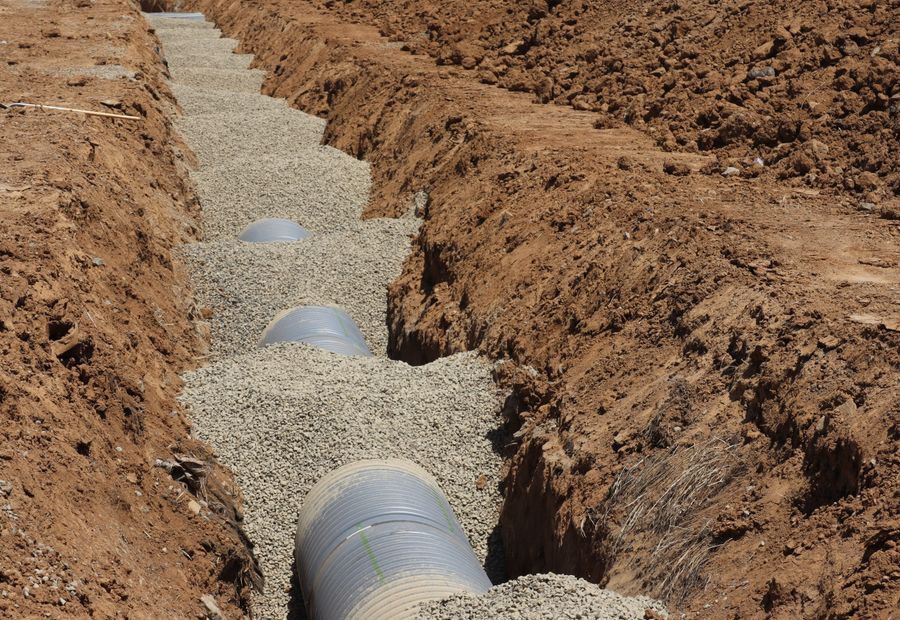
New trenches go in as perforated pipe bedded in washed drainage stone with non-woven fabric across the top, or as Infiltrator EZflow bundles where a stone truck has no route to the field. Pressure distribution laterals go in where the design calls for even loading rather than gravity. Every trench bottom gets cut level, and we shoot it rather than eyeball it, because a bottom with fall in it sends the whole day's flow to one end. Risers and lids come up to grade over the tank and the box, so the next person to service this system opens a lid instead of hunting with a probe.
The Sequence, Start to Finish
Soil evaluation. Design sized off that result. Permit application to Hamilton County Development Services and its groundwater protection division. Tank set and plumbed. Trenches cut, product placed, distribution built. Inspection while everything is still open. Backfill, final grade, seed and straw. Nothing gets covered ahead of the inspection.
Laying Trenches on Real Ground
Trenches follow the contour, not the property line. On a valley lot with clay residuum the field grows, because slow soil needs more surface to move the same daily flow. On a ridge lot the constraint flips to depth, and the layout works around where clean soil actually runs deep enough. We stake the field before the machine arrives and walk it with you, since the trees and the future shop location are easier to move on paper.
What You Decide, and When
Bedroom count and any future addition, before the design. Where the field goes and where the reserve area is protected, at staking. Whether you want risers at grade, which we recommend every time. Access route for the machine, before the dig. Everything else follows the soil report and the permit.
New Construction Timing
Builders lose weeks by ordering soil work late. Evaluation, design, and permit run on their own clock, and none of that can start after the framers show up. Get the ground read early. We quote and design whenever the ground allows, and we dig when the site is workable. Saturated clay moves a start date, because a machine working wet soil smears a trench wall shut. Call (423) 555-0125.
What is the order of work on a new septic install?
Soil work comes first, because everything after it depends on the result. Then a design that matches what the soil said. Then the permit application to the county. Then the dig, the tank set, the trenches, and the distribution. An inspection happens while the work is still open, and only after that does anything get covered. Backfill, final grade, and seeding close it out. Skipping the front of that sequence to save a few weeks is how a system ends up rebuilt.
What size septic tank does my house need?
Tank capacity follows the bedroom count, not the number of people living there today. The reasoning is that bedrooms travel with the house and occupants do not. A future owner with a larger family will use the same tank. Adding a bedroom later usually means revisiting the whole system, because the field is sized off the same count. Tell us what the plans say, and if you are considering a finished basement bedroom, say that now rather than after the permit.
Gravity or a pump, and who decides?
The site decides and the design records it. Gravity works where the field sits below the tank with usable fall, and it is simpler with nothing to fail. Its weakness is loading: the near trench takes the hardest hit and can seal while the far end stays dry. A pump doses the whole field in timed batches through small orifices, which loads it evenly and lets it rest between doses. Ground that runs uphill from the tank, or a design that needs even loading, gets the pump.
Can you install where a stone truck cannot reach?
Yes, and it is a common question on wooded and steep lots here. Infiltrator EZflow bundles the aggregate around the pipe in a net sleeve, and the bundles hand carry down a slope or through a gate where a stone truck has no route. Chambers carry in the same way. Both take stone hauling off the estimate, which on a hard access lot is a real part of the cost rather than a rounding error.